Saturday, March 3, 2012

Story Behind The Picture : "After The Day's Toil"

Story Behind The Picture

"After The Day’s Toil"

Friends,

Today I am before you with a photograph, “After The Day’s Toil”. This photograph was clicked in December, 2011 during my visit to Papikondalu (Andhra Pradesh). I was at this place regarding my presentation in a photography workshop. This beautiful place is situated on the bank of River Godavari and is covered with green hills from all the directions. The widely extended sand-beach by the river is an attraction of this spot. A number of activities, like fishing through the nets, tribal dances and glamour-shoots, were performed for the participants of workshop. This was one moody evening when two fishermen had just returned back from their daily doings. Out of them, the one was busy in anchoring his boat at the bank, and another one was folding his net. Their act fascinated me a lot. Moreover the vibrant colours of evening, pleasant reflections in water, the position of boats and the lamps on their front, seemed to be extremely attractive. Whole scene gave the impression of a painter’s imagination. I clicked a few frames of that sight. This is one of them.

I used a Nikon D 90 camera with a Nikon 18-105 mm lens. As the light was dull, I preferred high ISO (1600). The picture was clicked at aperture priority mode (with f -8).

--Dr. Pankaj Sharma


Saturday, February 18, 2012

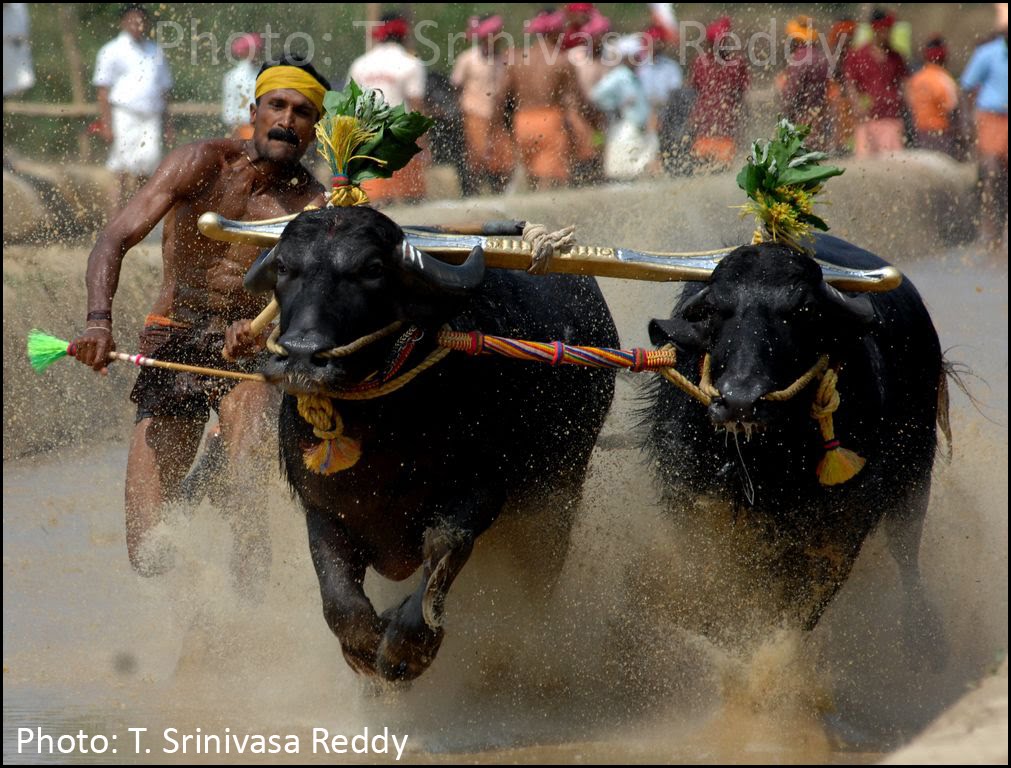
Photo Feature: "Kambala" by T. Srinivasa Reddy

Photo Feature

Kambala

Friends,

Mr. T. Srinivasa Reddy of Vijayawada (Andhra Pradesh-India) is a photo artist of high caliber. He is well known for his photographs of tribes in India, rural life and everyday events. He is associated with India Today’s telugu edition. Mr. Reddy’s work has been recognised all through the world. He is before us with a Photo Feature on Kambala, an important event of Karnataka.

--Dr. Pankaj Sharma

Kambala is a rural sport of Karnataka. This is well known for traditional buffalo race. The races are held in the southern coastal area of the state and takes place in muddy waters for a period of about 04 months (December to March) every year. This race is a show of speed and power in the slushy paddy fields. One can see buffaloes racing down muddy terrain which are goaded by farmers on a wooden plank. There is a huge gathering of people at Kambala, cheering the competing animals. The fastest pair among them wins the top prize.

The origin of the Kambala in Karnataka is difficult to trace. It is believed that it started long back as a recreational sport among the farming community with the beginning of harvest season. During this festival, farmers used to pay respect to the gods in order to get healthy crops. There were celebrations and games during the festival time. This was also the time for the second round of sowing of crops. The festival is celebrated with the same feeling at present also. There are two pairs of buffaloes competing among each other. Each pair of buffaloes is controlled by a farmer with a whip. In earlier times, the winning pair was given coconuts and a bunch of plantains. Today, the sport is more organized and has become professional. One can find thousands of spectators in any Kambala race. There are bets on the winning buffaloes with massive amounts. There are around 45 races that are held annually by the coastal area. In this number, around 18 Kambalas are held under Kambala Samithi and the rest take place under the auspicious hold of temples as well as many political patronages.

Though Kambala is an important festival in Karnataka, but the races related to this occasion have been criticized by animal lovers due to the use of whips on the participating buffaloes. They consider this act as barbaric and inhumane. In fact the sentiment behind this occasion is no doubt respectable but the voice of animal lovers is also highly regarded and should be taken seriously. The organizers of Kambala contend by saying, “if the whips are not used on these animals, they will not move”.

--T. Srinivasa Reddy


Saturday, February 4, 2012

Learning : Creating Pictorial Landscapes

Learning

Creating Pictorial Landscapes

Friends,

Creating pictorial landscapes is a profound desire of photography-lovers. “The photograph which looks picturesque and attracts one intensely at first sight is pictorial.” A few guidelines mentioned here can help us clicking a pictorial landscape.

Proper Light

1. Sun light of early morning or late evening is most excellent for preparing a good photograph.
2. Since this light is soft by character, this lends a hand in highlighting the fine details of the subject. What is more, this light helps colors appearing in their natural form.
3. The angular use of light adds depth and dimension to the scene. Sometimes light coming from behind the object also adds magic to our picture.

Equipment

The role of good equipments is very important. A D-SLR Camera with one standard zoom lens (such as, 18-55 mm, 18-70 mm etc.) and one tele photo zoom lens (such as 70-200 mm, 70-300 mm etc.) is enough for our purpose. In comparison to standard zoom lenses, telephoto zoom lenses are useful in the situation when we have to frame a particular portion of a view. If having two different zoom lenses is not convenient, we can go for a long-ranged zoom lens, such as, 18-200mm, 28-300 mm etc.

In case a high-end D SLR camera is not affordable for someone, there is a wide range of basic and advanced digital compact cameras in market. These cameras are good enough to record fine images. Landscape mode in these cameras helps to take fine images.
The use of a firm tripod is always advisable for shooting landscapes in order to prevent camera shake.

Depth

Great depth of field is a requirement of a landscape. For this purpose the use of small aperture (32, 22, 16, and 11) is always advisable. The shutter speed can be set accordingly. If we are using a small aperture in low light condition, a low shutter speed is obviously needed. In such case a tripod is of great use.

ISO Setting

Applying low/medium ISO is helpful in achieving fine-quality landscapes. On the other hand, use of extremely high ISO results into grainy images. So former one is always suggested.

Composition

1. We should always tend to compose the pictures with simplicity. Complex composition has to be avoided.
2. Composing the photograph so tightly is to be kept away. Openness of the frame is commendable every time.
3. Involving so many subjects in our photograph is not wise. We have to concentrate at one or at a few subjects.
4. The subject should be very much effective and must convey some message.
5. The harmonization between the subjects is another vital factor of an image. If subjects do not coordinate with each other, the photograph loses its charm.
6. Disturbing objects, like, electric poles/wires, discarded items etc. are to be avoided while clicking the image.
7. If we wish to involve living beings in our picture, it is wise to place them a little away from the midpoint. This will add balance to our image. Furthermore, living beings should look spontaneous.
8. The feel of rhythm is an important part of a good pictorial landscape. This can be created by balanced arrangement of the subjects.
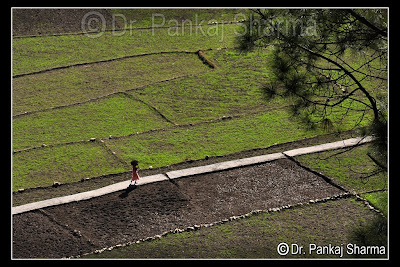
9. Leading lines play a dramatic role in a photograph. We can find these lines in the form of roads, rail tracks, boundaries of farm fields, rows of the trees, fencings etc. These lines lead our vision into the frame or from one point to another. In addition these lines boost rhythm in a picture.
10. The horizon of the scene should be straight.
11. There should be freshness of approach in our composition.

Man-Made Structures in Landscapes

Though natural physical features are the vital parts of a landscape, man-made structures also play an important role in few cases. Cottages, houses, temples etc. sometimes become imperative components of a landscape. If we keep some points in our consideration, we can brilliantly add above said structures in our photograph:

1. Manmade structures should not be very prominent in our photograph. They should be used as supporting elements. This is possible by maintaining proper distance between the camera and the structure or by using a wide angle lens.
2. We should avoid placing the architecture in the centre of a frame as it seems dividing the frame into two parts (left and right). It’s wise to place the supporting figure at any of the golden points as per the rule of third.
3. The structure of any vivid colour will add meaning to the landscape. We have to avoid the structures of dull colours.

Concluding Words

Beyond all the points discussed here, the aesthetic sense of a photo artist is the basis of creating a pictorial landscape. This is inborn in few cases. In some other cases, this develops through regular observation and one’s deep attachment with photography art.

--Dr. Pankaj Sharma


Saturday, January 21, 2012

"On Project" : Nainital Witnesses Snowfall

“On Project”

Nainital Witnesses Snow Fall

Friends,

Different hilly regions of India witnessed heavy snow fall in the beginning of January, 2012. In our previous post we focused at the snow fall in Shimla (Himachal Pradesh). In the same sequence we are here with a few photographs portraying the recent snowfall in Nainital, the beautiful city of Uttarakhand State. These images have been sent by Mr. Anup Sah, the renowned name in the field of art photography. Mr. Sah, a resident of Nainital, is well known among art lovers due to his extraordinary style of photography. He commands over photographing landscapes, mountains and wild life. He is a valuable contributor to our blog.

--Dr. Pankaj Sharma


Saturday, January 14, 2012

Photo Feature: Shimla Snow times

“Photo Feature”

Shimla Snow Times

Friends,

Sunil Parashar, a resident of Himachal Pradesh, is a fanatical photographer. He is a nature lover and enjoys being in the mountains. An electrical engineer by profession, he devotes his free time for photography, traveling and writing. He loves to tell stories, and photography is a medium which allows him to express his inner thoughts. His dream is to master the basics of photography and cover Leh-Ladakh extensively in the future. He is before us with a photo feature, titled, “Shimla Snow Times”

--Dr. Pankaj Sharma

“Imagine, it's your birthday, you return your home in the evening and realize that no one really bothers about this occasion. As the time goes by, your family surprises you with one of the best parties ever! This is what happened in Shimla this year.

Thousands of tourists thronged to Shimla to celebrate the New Year in the snow, but most of them were disappointed as there was no snowfall on New Year's Eve; rather, the snow came in the first week of January. And if you had witnessed Shimla before, in the winters, then you probably would have realized that this year it got one of the best snowfalls ever. There can't be a better New Year's gift.

On January 7th 2012, Shimla observed heavy snowfall throughout the day. Me, and my wife, Nidhi, decided to head to the Mall road, a popular tourist spot, and have a good time. These pictures are from that trip of ours. Hope you'll like them.”

--Sunil Parashar


Sunday, January 1, 2012

"Dashboard" - Heavenly View


"Dashboard"
Heavenly View
Friends,
Today I am before you with a photograph, titled “Heavenly View”. This image was clicked during the winters of the year-2010. I was on a trip to Gwaldam, a famous place of Garhwal (Uttarakhand, India). On one fine morning when I was strolling at a place situated at the outskirts of Gwaldam, I noticed a gorgeous sight. The blue ranges of the hills and two trees on the right side fascinated me deeply. I focused at the sight and all of a sudden a bird came into the vision and fulfilled the frame. I, without wasting time, pressed the button of my camera. This resulted into a memorable photograph which is before you.

In fact the presence of birds into a landscape is a mix of luck, patience and our attentiveness. Flying birds often add appeal in landscapes.

I used a Nikon D-90 camera and a Nikon 18-105 mm lens. The exposure was: Shutter Speed- 1/4000 sec. and Aperture- F 8.

--Dr. Pankaj Sharma