Monday, April 20, 2015

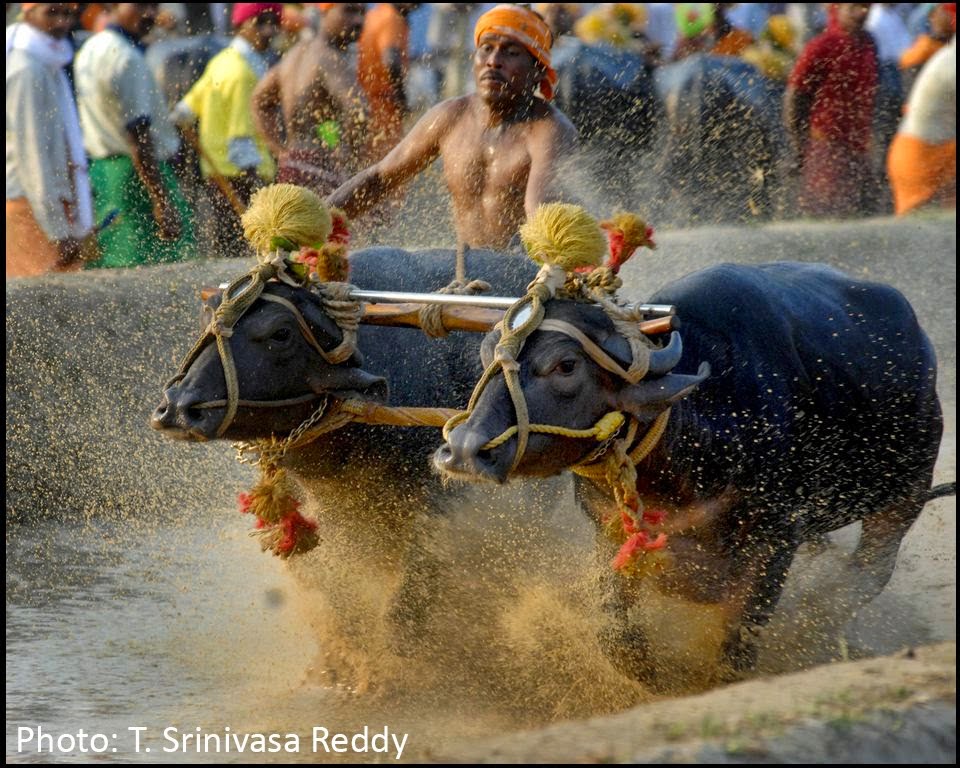
"From the Archive" -Photo Feature- "Kambala"

From the Archive..........

-Photo Feature-

"Kambala"

Mr. T. Srinivasa Reddy of Vijayawada (Andhra Pradesh-India) is a photo artist of high caliber. He is well known for his photographs of tribes in India, rural life and everyday events. He is associated with India Today’s telugu edition. Mr. Reddy’s works have been recognised all through the world. He is before us with a Photo Feature on Kambala, an important event of Karnataka.  -Dr. Pankaj Sharma

Kambala is a rural sport of Karnataka. This is well known for traditional buffalo race. The races are held in the southern coastal area of the state and takes place in muddy waters for a period of about 04 months (December to March) every year. This race is a show of speed and power in the slushy paddy fields. One can see buffaloes racing down muddy terrain which are goaded by farmers on a wooden plank. There is a huge gathering of people at Kambala, cheering the competing animals. The fastest pair among them wins the top prize.
The origin of the Kambala in Karnataka is difficult to trace. It is believed that it started long back as a recreational sport among the farming community with the beginning of harvest season. During this festival, farmers used to pay respect to the gods in order to get healthy crops. There were celebrations and games during the festival time. This was also the time for the second round of sowing of crops. The festival is celebrated with the same feeling at present also. There are two pairs of buffaloes competing among each other. Each pair of buffaloes is controlled by a farmer with a whip. In earlier times, the winning pair was given coconuts and a bunch of plantains. Today, the sport is more organized and has become professional. One can find thousands of spectators in any Kambala race. There are bets on the winning buffaloes with massive amounts. There are around 45 races that are held annually by the coastal area. In this number, around 18 Kambalas are held under Kambala Samithi and the rest take place under the auspicious hold of temples as well as many political patronages.
Though Kambala is an important festival in Karnataka, but the races related to this occasion have been criticized by animal lovers due to the use of whips on the participating buffaloes. They consider this act as barbaric and inhumane. In fact the sentiment behind this occasion is no doubt respectable but the voice of animal lovers is also highly regarded and should be taken seriously. The organizers of Kambala contend by saying, “if the whips are not used on these animals, they will not move”.

-- T. Srinivasa Reddy


Monday, April 6, 2015

Dashboard “Childhood Glimpse”

Dashboard
“Childhood Glimpse”

This time I am with a photograph, “Childhood Glimpse”. This was clicked in July-2014 when I was in Jodhpur, a picturesque city of Rajasthan (India). We can see the true traditional life style of India in the streets of this city. The houses in blue colour and the people in traditional colourful dresses take us into a different world. One fine day I was on a walk into the streets of Jodhpur with my friends (Mr. Sarvesh Joshi, Mr. Samir Madhukar Mohite and Mr. Dinesh Mowar). Mr. Sarvesh Joshi is the resident of this city. He took all of us to the best areas. While strolling in a street situated near by Mehrangarh Fort, I saw an old house with blue walls where an innocent boy was sitting near the entrance. There was an old bicycle in the background. The yellow T-shirt of the boy and the blue wall together presented an ideal example of complimentary colours. The small boy seemed unaware of the worries of human life. After an informal interaction I pointed my camera towards him. As I starting clicking, he put his both hands on his face in a distinctive way. He perhaps felt shy of the camera. However, his gesture portrayed a spontaneous glimpse of “childhood”.
The world of children is unique in all regards. Every child has his individuality and self respect. All of us not only give them due respect and love, but must help them in shaping their personality. They are the future of nation.

--Dr. Pankaj Sharma 


Sunday, March 22, 2015

-Profile- Living with Fascination Bhumesh Bharti

-Profile-
Living with Fascination
Bhumesh Bharti
 Born on 13th June, 1969 in Dehradun (Uttarakhand-India), Bhumesh is a self-taught photo-artist. He started clicking as a hobby when he was in class 9.  After doing his graduation he got a chance to work for National Literacy Mission of Bharat Gyan Vigyan Samithi- Delhi. During this project he had an opportunity to travel many villages of different parts of India. This created his interest in Social Life photography. Here after photography became his passion. Later Bhumesh worked for many important organizations. His creative works proved to be of great importance for all these bodies.  
Though he is well competent in various branches of photography, he mainly focuses on capturing people and places. He is a free lance photo journalist. As a photo journalist, he not only clicks, he writes also. Whenever he gets chance, he feels satisfied in making documentaries over social issues. While doing this he always gives importance to story-telling value.
To encourage the art of photography among new comers and students he started Colored Leaf Photography Group in 2012.  Today there are about 500 members in this group. This group has organised many exhibitions and workshops till date.   
Bhumesh has to his credit many prestigious awards and recognition.
--Dr. Pankaj Sharma 

Monday, March 9, 2015

-Dashboard- “Innocent Childhood”

-Dashboard-
"Innocent Childhood"
This time I am before you with a photograph, titled, “Innocent Childhood”. This image is one of my favorites. This photograph was clicked in Abhaypur Village of District Pilibhit (U.P, India) around 10 years back. I was there for documenting the archaeological excavation conducted by The Department of Ancient History and Culture, MJP Rohilkhand University, Bareilly (where I work). A day I was strolling nearby our site in leisurely mood during the tea break. I suddenly saw this small girl standing in the field of wheat. She was watching at our team with curious expressions. Her innocence fascinated me deeply. Furthermore her red-colour dress against the golden crop of wheat seemed quite eye catching. I did not delay to portray her. Out of the clicked frames, this is one of them. I used a Nikon F 80 camera with a Sigma 170-500 mm lens.

The children in the villages are often far away from the complexity of the cities’ life. They are much down to earth, and so they are unique.

Dr. Pankaj Sharma


Saturday, February 21, 2015

-Profile- A Dream Weaver: Rudrita Chatterjee

-Profile-
A Dream-Weaver
Rudrita Chatterjee

Rudrita Chatterjee is a fashion designer by profession, having her fashion brand “RUDRITA”. She is M.A. in English and Graduate in Fashion Designing. She possesses Diploma in Fine Arts as well.
She stepped into the world of creative imaging three years ago. In her short voyage of creativity she has proved herself as an innovator.  She has won many national and international awards and her creative works have been exhibited in more than 25 countries.  She captures the subjects through her lens and then treats them with her mind’s eye, compassion, love and sentiments. Her images take us away from our own world, and we find ourselves in an imaginary planet for a while. 
Beside her interest in creative imaging, she loves travelling and capturing the beautiful aspects of nature.
Whenever she is free, her favourite pastime is reading books and doing painting.

--Dr. Pankaj Sharma


Friday, February 6, 2015

-Learning- Landscape Photography: My Perception

-Learning-
Landscape Photography: My Perception

Landscape photography is a most beloved subject for the photo artists all through the world. The treasure of stunning landscapes waits for photo lovers in different seasons. Landscape Photography shows spaces within the world, sometimes vast and unending, and some other times limited. A Landscape Photographer in general captures the presence of nature but can also focus on man or man-made features. With a few points in our consideration we can achieve desirable landscapes.

1. Basic Requirements
I.   SLR Camera.
II. One standard zoom (such as, 18-55 mm, 18-70 mm or 18-135 mm).
III. One tele photo zoom (such as 70-200 mm or 70-300 mm). 
IV.   Wide angle Lens (10.5 mm, 14 mm Or 16 mm).
(If SLR camera is not within our capacity, a good quality digital compact or prosumer camera can help us well.)
V.    A firm tripod to prevent camera shake during low light conditions.
VI.   Proper knowledge of equipments with their merits   and limitations.

2. Good knowledge of the chief characters of the particular place:
We should have good knowledge the chief characteristics of a place, like Flora/fauna and important geographical features. We have to aim at portraying the places in their true manner by including these chief characters.

3. Photographing in Early Morning/Late Evening Light:
The natural light of early morning and late evening helps us to get gentle images with vivid colours and fine details. This may be one sided or against the camera (Back Light). Both have their own qualities.


4. Story Telling Value:
If a photograph conveys some story, it is always appreciated.


5. Use of Filters
In order to get the excellent images, we can use at least three filters when we are shooting in colour medium.
I. Polarizing Filter: This filter darkens the sky and consequently brings out the blue colour in contrast to the white colour of the clouds.
II. Neutral Density Filter: Neutral Density Filter prevents excessive amount of light to enter the camera. This Filter is useful during extreme bright days, when our camera is not capable to provide us a slow shutter speed. This helps nicely when the light is hard and we need a slow shutter speed to capture the water stream with flowing effect.
III. Graduated Filters: These filters are half coloured and half plain. The upper coloured portion gradually turns into neutral as our eyes sees down. These filters help adding different colours to the dull sky, leaving the lower portion of image unaffected.

6. Great Depth of Field
 The sense of depth with all the different elements of the scene in focus makes a photograph dynamic. For this purpose we should use a small aperture (32, 22, 16, and 11). We can set the shutter speed of camera accordingly. In low light conditions, the use of small aperture will need a lower shutter speed. In such situation the use of a tripod is always recommended.


7. Including People and Man-made Structures
 Although a landscape is connected to nature, we can include people and beautiful buildings in an image to create interest. A landscape can be balanced by a pretty child, some working people in the fields or an eye-catching structure. But we have to place the human figure or building at an off-center position to create balance.


8. Good Composition
I.  Simplicity: We should try to compose the image in a simple manner. 
II. So many objects are be neglected. We have to concentrate on one or limited objects.
III. Disturbing elements (like, electric poles/wires, discarded items etc.) are to be avoided
IV. Place the human beings or a man made structure (like hut or temple) a little away from the center. This will add balance to the picture.
V.  Tight Composition is to be kept away. Openness in the frame is commendable.
VI. Leading lines play a dramatic role in a   photograph. We can find such lines in the form of roads, rail tracks, rows of the trees, fencings etc. These lines lead our vision into the frame or from one point to another. In addition leading lines boost rhythm in a picture.


VII. Coordination between the subjects is another vital factor of an image. If they do not coordinate with each other, the photograph loses charm.
VIII. The feel of rhythm is an important part of a good photograph. This can be created by balanced arrangement of the subjects.


IX. Including the trees in the frame doubles the beauty of an image. If a scenic place has trees, we should not fail to include them in our picture.


X. Horizon of the scene should be straight.
XI.   There should be freshness of approach in our composition. We have to be original in our presentation. Copying the idea of others is not a commendable practice.

9. Keeping Extra and Fully-Charged Camera-Batteries and Surplus Memory Cards:
This helps out evading disappointment during crisis.

10.  Care of Camera:
As our camera is very important during a trip; we have to take extra care of the camera. A small negligence can harm it.

-Dr. Pankaj Sharma