Monday, June 20, 2016

-Dashboard- “Walk into the Lap of Nature”

-Dashboard-
“Walk into the Lap of Nature”

This time I am before you with a photograph titled, “Walk into the Lap of Nature”. This picture is important for me because this is full of sweet memories of Sheetla khet, a scenic place near to Almora (Uttarakhand). One nice morning I was on a walk near to Sheetla khet with my beloved friend and a renowned mountaineer, Mr. Gopal Sharma. While having a leisurely walk I noticed a beautiful tree with yellow leaves on the left of a curve in road. This was a co-incidence that my friend was also wearing a yellow jacket. The yellow leaves of tree, my friend in yellow jacket, the curve of the road and greenery all around offered a good opportunity for a pretty picture. I clicked a few frames. This is one of them.
Nature is full of wonderful compositions. The important thing for us is how we visualize a picture.
I used a Nikon D 90 Camera with a Nikon 18-105 mm lens.

--Dr. Pankaj Sharma 


Saturday, June 4, 2016

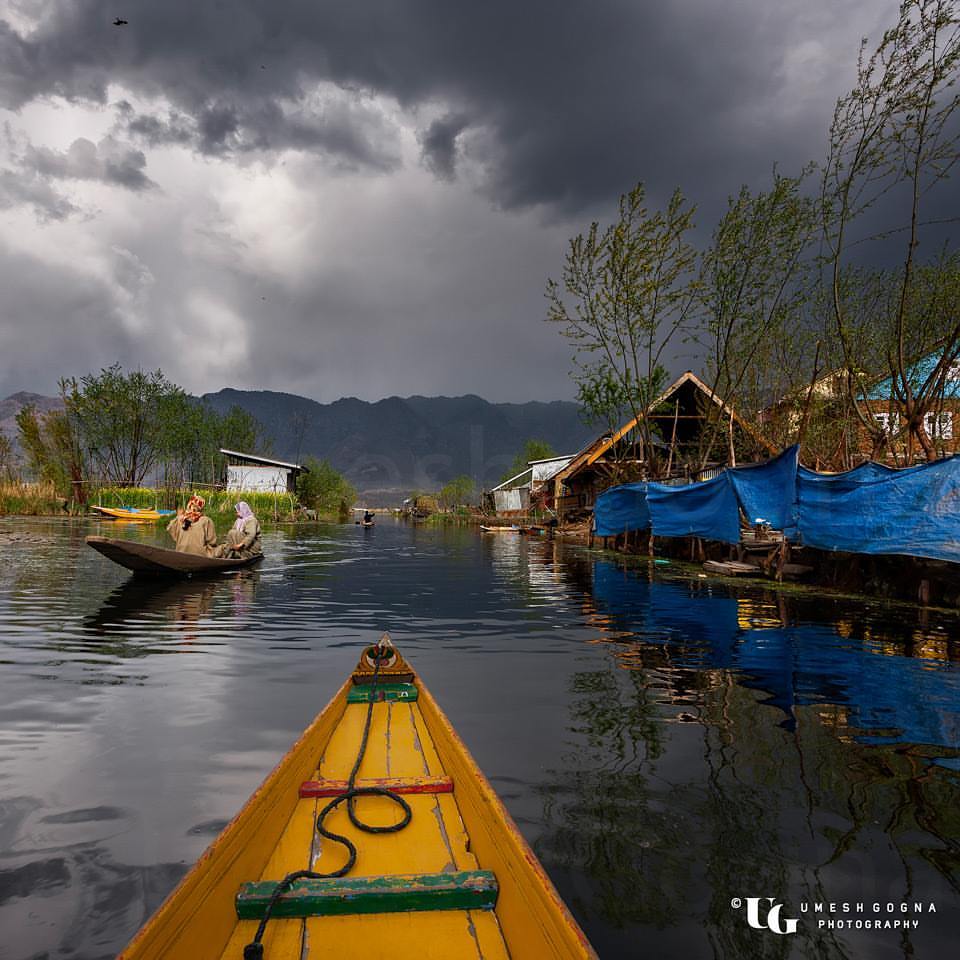
-Profile- In Companionship of Photography: Umesh Gogna

-Profile-
In companionship with Photography
Umesh Gogna
Born in a family of jewelers, Umesh Gogna was inclined towards arts since his childhood.  After completing his post graduation he started helping his father in his family business while also working on his Ph. D thesis on ancient Indian jewelry. He needed good quality photographs of jewelry for his thesis. In order to get good images for his thesis, he decided to buy a camera and try photographing the jewelry himself. He bought a second hand Pentax camera kit, thus started his journey as a photographer.
After some disappointments, and a lot of hard work, he was able to get good images for his thesis. After a phase of time, he discovered that he had fallen in love with photography and he started spending more and more time with this form of art. He upgraded his camera kit, brought studio lights and even set up a small studio in his house. Soon people started asking him to photograph their jewelry-products and he was happy to oblige them.  As he loved travelling, he started travelling to new destinations with his camera. During these trips he got fine images of different places. 
When he realized that he was devoting more time to his photography than to his family business, he decided to turn professional and devote all his time to photography. It was a difficult decision as he was essentially leaving a secure business for the uncharted waters of professional photography. But now, after so many years, he is glad that he made that choice. Photography has always been the main passion of his life and he feels especially lucky and blessed to be able to devote all his time to it.
Most of his professional work is in the field of handicraft and jewelry, stone and the hospitality industry. Apart from his professional work he also does a lot of travel and nature photography. Over the years he has spent a lot of time in documenting the cultural architectural and natural heritage of Rajasthan and the Himalayas. The wilderness and the open paces of the desert and the mountains attract and inspire him.
After spending many years as a professional photographer, he felt that he should give back something to the profession of photography. One area where he felt he could contribute was by educating aspiring photographers about the science and art of photography. He started helping young photographers by conducting workshops. He has conducted more than 150 workshops on different topics till date.
Today Umesh Gogna is a well known figure in the field of photography. He is among the jury members of renowned photography contests. Many organizations have appointed him as their mentor. A number of his photographs have featured in reputed publications. He is committed to help the beginners forever.

-Dr. Pankaj Sharma

Sunday, May 15, 2016

-Dashboard- "Made for Each-Other"

-Dashboard-
Made for Each-Other

This time I am before you with a photograph, titled, “Made for Each-Other”. This picture was clicked during January-2016 at Babu Ghat, Kolkata. I had a chance to visit this Ghat on one morning. This was an entirely new experience for me to be there. I could see people busy in different activities and rituals. While being there I watched this newly-married couple. They had come here to perform a certain ritual which is supposed to be of big importance after marriage ceremony. The Bride with innocent expressions and the Bridegroom curious to say something to Bride seemed so interesting that I got motivated to take a picture. In addition their sitting postures appeared very spontaneous.  The ritual-materials in front of them added feel to the occasion.
I clicked a few pictures. This is one of them.
I used a Nikon D 90 Camera. The lens was Nikon, 18-105 mm. Exposure was f-5.6, 1/400. The ISO was set at 500.

(Sincere thanks and best wishes to this newly wedded couple)

--Dr. Pankaj Sharma


Sunday, April 24, 2016

"Great Masters" :

-Great Masters-
Depicting Life’s Philosophy through his Pictures
Raghu Rai

Raghu Rai is a world renowned photo artist from India who portrays the life in such a realistic way that his pictures seem telling some story with a philosophical touch. His creations are milestone in the field of art photography. If one has to experience the essence of life, he/she must go through the masterpieces of Mr. Rai.           --Dr. Pankaj Sharma                                        

“Raghu Rai (1942) a qualified civil engineer, began his career as a photographer at the age of 23 in 1965. In the early years of his career he was the chief photographer at The Statesman (1966 to 1976), and later the Picture Editor of Sunday magazine (1977 to 1980).
Soon after completing the Thomson fellowship in England, he worked in The Times, London for four weeks. Within this short time span three half pages picture essays of his work were published with a byline. Recognizing his creative potential, Mr. Norman Hall, the illustrious editor of The Times offered him a job, but Raghu preferred to return to his own country to continue his creative journey in the lanes and by lanes of his motherland. 
In 1971, impressed by his work in an exhibition at Gallery Delpire, Paris, the legendary photographer Henri Cartier Bresson nominated Raghu Rai to Magnum Photos, the world's most prestigious photographer's cooperative. Raghu continues to be part of this organization till date. Around the same time he was awarded the 'Padmashree' (1972), for the body of work he produced on the Bangladesh war, its impact on people and finally, the surrender.
Rai became the Picture Editor-Visualiser-Photographer of India Today, India's leading news magazine in its formative years. He worked on special issues and designs, contributing trail blazing picture essays on social, political and cultural themes (1982 to 1991). His series on Great Masters of Indian Classical Music, film maker Satyajit Ray, Mother Teresa, had become talking point of the magazine.   In 1992 he was awarded "Photographer of the Year" in United States for the story "Human Management of Wildlife in India" published in National Geographic. In 2009 he was conferred Officere des Arts et des Lettres by Government of France.   Photo essays by him have appeared in world's leading magazines and newspapers - Time, Life, GEO, Le Figaro, Le Monde, Die Welt, The New York Times, Sunday, The Times-London, Newsweek, Vogue, GQ, D magazine, Marie Claire, The Independent and New Yorker. He has been an adjudicator for World Press Photo Contest, Amsterdam and UNESCO's International Photo Contest for many times.
 The photo documentation of 1984 Bhopal Gas Tragedy by him, and the continuing effects of the gas on the lives of the victims under a special assignment from Greenpeace International were compiled into a book.  3 sets of this work travelled as exhibitions in Europe, America, Australia, India and South East Asia from 2002 to 2005. This created greater awareness about the tragedy which brought relief to the survivors.  Raghu Rai tirelessly continued to photograph India through the 20th century and now into the 21st. His monumental body of work of myriad themes is certainly a slice of India's modern history because of which he has come to be known as the father of photo journalism in India. 
 Several books have been produced of his work.  Some of them are : Indira Gandhi (1971, 1985, 2004 ); Mother Teresa -Faith & Compassion (1971, 1996, 2004); Bihar shows the way (1977); The Sikhs (1984, 2002), Delhi (1971, 1985, 1992, 2008 ); Romance of India (1985); Taj Mahal, (1986, 2012); Calcutta (1989, 2008, 2013 ), Khajuraho (1991), Tibet in Exile (1991, 2009, 2012), My Land and it's People (1995); Lakshadweep (1996); Men Metal and Steel (1998); Madhya Pradesh (2000); Raghu Rai's India (2007, 2008); India's Great Masters -a Photographic journey into the heart of classical music - 2010; Bombay - Mumbai -where dreams don't die -2010; The Indians - 150 years of portraiture in India - 2010; Varanasi -Portrait of a Civilization - 2010; Bangladesh -The Price of Freedom ­2012; Trees -2013; Mahakumbh 2014; Vijaynagara - Ruins to Resurrection 2014 etc.
Besides winning many national and international awards, Rai has exhibited his works around the world. Some of the major exhibitions include Retrospective at Museo de Capitolini- Rome- 2005 ; Retrospective of his work at Arles Photography Festival -2007 ; Asiatica Film Mediale, Rome - 2008; A Retrospective - National Gallery of Modern Art, New Delhi -2008 and at the National Gallery of Modern Art, Mumbai -2008; at Aicon Gallery, London 2010 ( this show received full page coverage in Sunday Guardian, The Times, BBC and various other publications; Women Changing India - Saachi gallery, London 2011.
 Exhibitions of his work were held in Gallery Delpire, Paris - 1971; Nikon Gallery, Tokyo -1972; Gallery Tsurumoto- 1992; A Retrospective at Bunkamura Museum, Tokyo -2001; Kendamy Museum - Italy, 2002; A Retrospective at Photofusion, London, UK - 2002; at Volkart Foundation, Winterthur, Switzerland- 2002; at Sala Consiliare, Venice, Italy -2003; at the Photographic Gallery, Helsinki, Finland - 2003; Drik Gallery, Dhaka, Bangladesh - 2004; Museo di Storia Naturale- Milan; Gallery Caolmine- Switzerland; Centro Cultural Recoleta- Argentina; Centro Universitario Belas Artes- Sao Paulo; Leica Gallery-Prague,  2004; Melkweg Gallery, Amsterdam, Netherlands -2005; Art Car Museum- Texas (Houston); Fait et Cause Gallery -Paris; Earthscapes series, Singapore - 2007; Just by the Way - Clouds, Rocks and Nudes, India - 2007 ; Master Musicians of India - Singapore - 2007; Raghu Rai's India -Pathshala, Drik, Bangladesh 2009; Master Musicians of India - Lalit Kala Academy -Delhi 2010; Mother Teresa, A life Dedicated - Visual Art Gallery, Delhi and Kolkata 2010; India - Mexico -The Parallel Wings - Instituto of Cervantes, New Delhi ­2010; Calcutta -Kolkata, Harrington Street Arts Center, Calcutta, 2010; Format Festival Jan 2011; Raghu Rai' s India, A Retro at Foto Freo Festival, Australia, 2011; India- A touring exhibition in Brazil, 2012; Price of Freedom, Bangladesh -Bengal Museum of Art, Dhaka, 2012; Outside the Margins-Photo exhibition for Save The Children, New Delhi-2012 ; TREES at Photo Ink, Delhi 2013; Longing to Belong-Refugees in India, UNHCR-New Delhi, 2014; In Light of India-A Retrospective, Hong Kong International Photographic and Cultural, Aug/Sept 2014. 
 Raghu Rai lives in New Delhi with his family and continues to be an associate of Magnum Photos.”

(Text and pictures courtesy: Raghu Rai)


Monday, April 11, 2016

Dashboard: “Whipping to Win”

-Dashboard-
“Whipping to Win”

On the occasion of Kartik Poornima (after Deepawali) there takes place a grand annual event of Horse Race at Chaubari Village of District Bareilly of Western U.P (India). This village is situated very close to river Ramganga.  A number of activities are organized in this fair. Horse race is one of them. Actually this race is a type of display of the capability of horses. The horse-sellers come from different parts of the region to this fair. They try their best to show the skills of their animals. The purchasers observe the race alertly and the horses which are found most excellent are sold at high prices. 

This photograph titled, “Whipping to Win” is an attempt to portray the expressions of a rider who is whipping his horse in order to win the race. On the other hand the body language of horse confirms the influence of the hit of whip. The other riders in the background seem to be the reason of leading rider’s action. The dust all around seems adding to the beauty of the picture. 

Though violence with animals is being opposed everywhere in the world, such acts still exist. People take these activities as a part of their culture and tradition.
(I took this picture with Nikon D-90 DSLR camera at shutter speed priority mode (at 1/1000 sec.). The lens was 18-105 mm (Nikon). ISO of the camera was set at 500.)

--Dr. Pankaj Sharma


Wednesday, March 30, 2016

"Learning" : A Simple Ambient Light Portrait

-Learning-
A Simple Ambient Light Portrait
Here is a black and white portrait. Let’s analyze the picture
(By -Rohinton Mehta)
 Pose:
The subject looks comfortable and the head is slightly tilted (as it should be). The eyes are not parallel to the top of the frame. This follows an unwritten guideline that an imaginary line running across the center of the eyes shall not run parallel to the top of the frame. Observe the shoulders, slightly tilted to one side. This too is a      
fundamental point to consider when posing your subject. Hands play an important part in posing. Observe how nicely the fingers are clasped. Check out the distance between the top of the head and the frame – not too much, not too little.
Note: Generally, you place the subject at a slight angle to the camera. In this case the author has taken care that the subject’s head is slightly turned and not directly facing the camera.

Camera Position and Lens:
Generally we align the camera at the subject’s eye level, as done here. A higher camera position would have shown more of his balding head, which could be considered wrong. A lower camera position would have placed more emphasis on his clasped hands.
It is important to use the right focal length for the lens. The choice here is perfect. A wider lens used closer to the subject would have made the hands appear larger, which of course would be wrong, unless you were trying for some special effect. The hands are slightly away from the chin and look perfectly natural.

Lighting:
This is an ambient light portrait (though you could replicate the lighting using just one light in a studio, as mentioned later).
Defused day light is from the right of the camera position and is coming down at around 45 degree to the subject. The angular light has cast a soft shadow of the nose, and has also caused the needed highlighted triangle under the subject’s right eye. A large white reflector was placed on the subject’s right to “fill-in” the shadow side of the face. How close or how far you hold this reflector determines the illumination on the shadow side.
If this was studio set-up:
If this was a studio set-up, you would place the (key) light in a similar fashion. With studio light you have to try and simulate the ambient lighting you see in nature. Since you cannot physically change the position of the sun, you change the position of the subject in relation to the sun. With studio lighting – that is, when using artificial lights, the distance between the key light and the subject is very important. If this light is too close, you could lose the specular quality; if too far, the highlights could diminish. Hence, the correct distance is achieved by trial and error while observing the lighting through camera position. Another point to bear in mind with artificial lighting is to try and use “feathered” lighting; that is, set the light in such a way that the edge of the light is used rather than the central area. This is the preferred method of portrait masters as it provides a better modelling to the face.
 
Printing:
 The idea is to let the viewer’s eyes concentrate on the main part of the subject- the eyes and face. To achieve this, you can use a dark background and use a second light on the background that would separate the subject from the background. Alternately, if you are using only one light, you can darken the corners during printing as done here. This forces the viewer’s eyes to gaze on the subject’s face.
Observe also the subject is wearing white clothes. White tones draw your attention towards them, and so to avoid that, the white clothes have also been toned down (made to look grey) during printing.

Presentation:
The final presentation is as important as whatever else goes into the making of a picture. A thin white stroke, along with a thicker black border not only stops your attention from wandering out of the frame, it also adds a touch of elegance to the final product.

-- Rohinton Mehta

(Technical Editor-Smart Photography)

(Article courtesy: Smart Photography, December-2010)


Monday, March 14, 2016

Event- "Drishti-2016" : An Exhibition by Photo Vision's Members

-Event-
"Drishti-2016"
An Exhibition by Photo Vision's Members

Photo Vision, Bareilly (India) organized an exhibition, titled "Drishti-2016 on 12 and 13 March-2016 in IMA Hall. The exhibition consisted of around 100 pictures by the members of Photo Vision which focused on "Shades of Life".  The pictures depicted diverse facets of human life.  Among the participants were Mr. Gopal Sharma, Dr. Tarun Kumar Verma, Mr. Bijan Das, Mr. Deepak Ghosh, Dr. Anupam Sharma, Dr. Pankaj Sharma, Dr. Kamran Khan, Dr. Lovelesh Dutt, Mr. Satpal Singh, Mr. Bipin Mehra, Mr. Rakesh Kachchal and Mr. Gaurang Dixit.  A number of art lovers visited the show and appreciated the creative works.
On this occasion, Dr. Kamran Khan and Mr. Satpal Singh were honoured for their outstanding achievements in the field of art photography.
Mrs. Preeti Srivastava, Deputy Director of Tourism, Bareilly was the chief guest.

--Dr. Pankaj Sharma


Sunday, February 28, 2016

-Profile- Capturing Decisive Moments of Life : Raj Sarkar

-Profile-
Capturing Decisive Moments of Life
Raj Sarkar

Working as finance personnel in Airports Authority of India at Kolkata, Raj Sarkar is a photographer by passion. He enjoys travelling & loves documenting street life. His photographs have won several awards and have got place in several publications like National Geographic, Asian Photography Magazine, Smart Photography Magazine, Saveus Magazine (Wild life), Street Photography Magazine, Chalo lets go, Photo Burst, Photo Flock, World Street Photography, Wild bird trust, 121clicks.com, Nikon India, Pinterest etc. He has been short listed under top two hundred in Garuda world photo contest in two different categories as well.

Photography for Raj Sarkar is to capture decisive moments of life. The most important thing for Raj as a photographer is to respect his subjects and the ambience. According to him we are not going to get good photo every time we shoot. But we should try exploring things which are new and unique. Raj thinks that his camera is his constant companion wherever he goes. He believes, if we are in a habit of taking photograph everyday then it will become a reflex action and our mind will instruct when to click and what to click. He thinks that one has to be the true critic of his own photos. He prefers to review his own photographs repeatedly on a regular basis to develop photographic sense. Reading various photography magazines has become his habit in order to get updated with the new technology invented every day in the photographic field.
His favorite photographers are Raghu Rai, Henry Cartier Bresson, Sebastiao Salgado and Ansel Adams.
--Dr. Pankaj Sharma


Monday, February 8, 2016

Dashboard : "Emotional Bond"

-Dashboard-
“Emotional Bond”

This time I am before you with a photograph, titled “Emotional Bond”. I was on a trip to Munsiyari (Uttarakhand) a few years back. One pleasant morning, while travelling on the outskirts of this town, I saw this girl with her goats. She was carrying them for grazing-land. I came out of our car and started clicking her pictures. She asked me to wait for a while and took a small goat in her lap with innocence. This act of her appeared very spontaneous and heart touching and depicted true emotional bond between two living beings. I can never forget the way she took her goad in her lap, and of course for a photograph. Her love for the goat seemed teaching us the value of emotional attachment, not only for our fellow beings, but for innocent animals as well.

--Dr. Pankaj Sharma


Sunday, January 24, 2016

-Youth Gallery- In Pursuit of Nature and Wildlife Photography: Arjun Haarith

-Youth Gallery-
In Pursuit of Nature and Wildlife Photography
Arjun Haarith

Born in the garden city of Bangalore on December 16th, 1989, Arjun Haarith has deep inclination towards nature since his childhood days.
He used to accompany his uncle Mr. H Satish (who is a famous wildlife photographer) during the initial days of his career. Mr. Satish used to take him for bird watching and nature trips, which helped him to become a Nature and Wildlife lover. Due to his uncle’s companionship, he understood many things about wildlife and Nature conservation. Whenever he used to see the beautiful wildlife images of his uncle, he dreamt of being a wildlife photographer. Mr. Satish’s passion and dedication for nature and wildlife inspired Arjun to become a Nature/Wildlife photographer.
Back in 2007, he started to take this hobby seriously which then became his favorite passion. Arjun has traveled to many places in India till date. Now travelling the places has become his serious hobby. His father, who is a person with varied interests and hobbies, always inspires him in his endeavors.
Nature and Wildlife are Arjun’s main interest in photography, but he likes to photograph people and street as well.
Of late, he is trying his hand in Astronomical photography, Night sky and Time lapse. The results in this field are equally good.
He has done his engineering in the Information science discipline, at SJBIT, Bangalore and is currently working as a Software Engineer in Adobe.
Arjun is a recipient of various acclaimed photographic awards and many of his photographs have been exhibited in different salons across the India. Some of his pictures have been published in WWF calendar, Better photography magazine, BNHS greeting cards and many other travel guides and books.
 --Dr. Pankaj Sharma